
the great bearing debate
Now here’s a touchy subject for many reel tuners, bearings. What is it about them that draws so much controversy? In this post I will dispel some myths and the marketing behind bearings. By the time you are finished reading this post, you will be armed with new knowledge enabling you to make a more informed choice. For starters, bearings are cheap. Aside from the springs, screws, and other hardware, bearings are one of the cheapest components in a reel. Cheaper than the spool, the gears, the handle, the frame, the side plates, you get the idea. Bearings also have the highest markup of any other component simply because of the hype surrounding them, especially aftermarket bearings. All across the internet, you see stores and reel services pushing bearings. Ceramic this, silicon nitride that, ABEC whatever, you get the idea. That is all there to get you to click the buy button, making extraordinary claims without demonstrating extraordinary results. As a matter of fact, there are businesses that make quite lucrative profits off of this business model. For instance, some competitors of mine offer their services cheaper than myself, but there’s a catch. They will talk up flavor-of-the-month bearings in hopes that you commit, because it’s easy money. They can sell their services at a potential loss while more than making up for it by pushing products with a very high markup. If you’ve found your way to this site, you are probably familiar some of those services and resellers. Just do a Google search for ‘fishing reel bearings’, and you are going to get a lot of hits for overpriced bearings. What if I told you the markup on these, in the chain from the manufacturer, to the retailer, to the end user could potentially be higher than 2000%? Yes, you read that right. That is no exaggeration. Most of those bearings come from facilities with poor QC, along with cheap tooling and material quality. Manufacturing accuracy is up in the air, and as such, they label their specifications however they want. In the past when I’ve experimented with these bearings, it was very difficult to find any two that spun the same, indicative of poor quality control. This wasn’t that long ago either. Take that for what it’s worth.
Bearing resellers often like to market a bearing based on its ABEC rating. So, what is the ABEC scale exactly? It’s a set of standards put forth by the Annular Bearing Engineering Committee, a committee of the American Bearing Manufacturers Association. The ABEC scale goes from 1 to 9, with 1 being the loosest tolerance and 9 being the tightest. Any ball bearing rated at least ABEC 1 qualifies as a precision bearing. ABEC standards specify the tolerance of how a bearing fits to a shaft or housing, nothing more and nothing less. The standards do not take into account Rockwell hardness, raceway finish, ball quality, or internal tolerances. Unfortunately, bearing resellers use the ABEC system as a marketing tool to move products, giving the impression that the ABEC rating is indicative of end performance. As a matter of fact, too high an ABEC rating can be detrimental in some cases, especially a fishing reel. If a bearing fits too tightly, it will be counterproductive to end performance since the raceways will deform under pressure, adding friction as they spin. Human nature is that of abundance; higher numbers sell products because the human side of us says more is better. The bearing resellers have the same mentality as the rest of us, relying on our mutual misunderstanding of the ABEC system to sell products. If one were to look at the product catalogs of any quality established bearing manufacturer, ABEC is seldom, if ever mentioned. About the only time it is mentioned is if it’s for a special use bearing, like a high speed spindle or other tool that operates at a RPM far beyond what a reel spool will operate. Take a look at AliExpress and you will find that most bearings sold there are sold on the ABEC system, regardless if those products follow the standards or not.
As for reel manufacturers, the bigger players go with reputable brands. Daiwa, Shimano, Isuzu, and Doyo-manufactured models like Lew’s and Abu Garcia all use NMB bearings. NMB is the largest precision bearing manufacturer in the world, supplying over half of the ball bearings the world over for applications like fishing reels, dentistry tools, precision machining tools, and aircraft instrument panels. Fishing reels aside, those are all mission critical environments where quality comes first, and one would never find any of them running bearings of questionable quality. Quality ball bearings come with a light grease applied simply because they require grease in the conditions they are commonly used. When the reel manufacturers receive those bearings, they put them straight into their products, grease and all. As we know, grease hampers spool rotational performance with baitcasting reels. Where bearing swappers see the upgrade with hyped bearings, they didn’t have a clean bearing to begin with. The fly by night bearings most buy for their reels come clean, so they may in fact feel like an upgrade because they are right away compared to a greased bearing. This gives the illusion that the inferior bearing is in fact an upgrade.
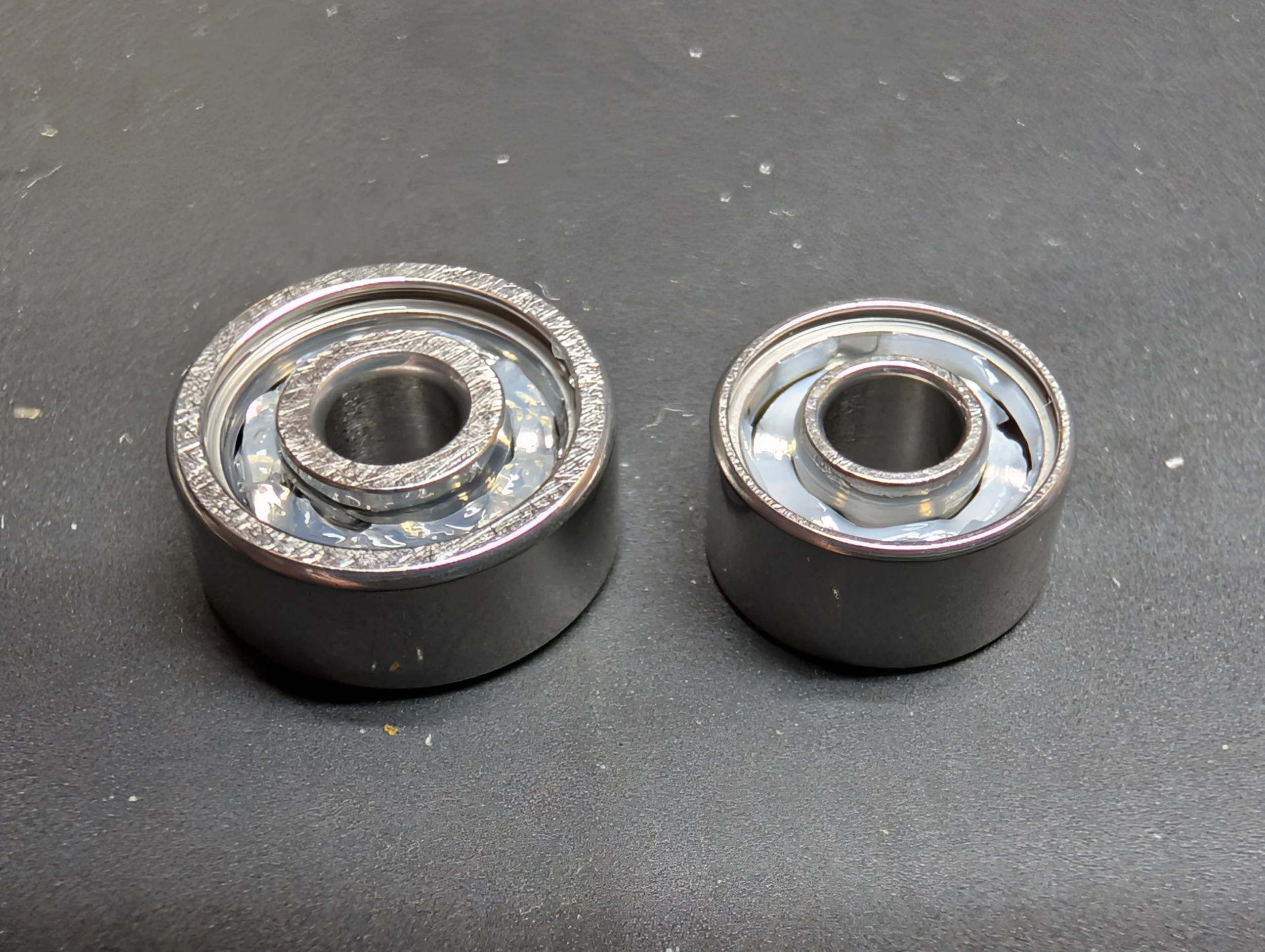
NMB DDR-1030ZZ and DDR-830ZZ shields removed, just as manufacturing partners receive them
Continuing on. Reputable stainless bearings are good, really good as a matter of fact. Even with the bearings greased from the factory, they still spin satisfactorily. They may not spin for a very long time when run on a bearing check tool, but for actual fishing conditions, they are completely fine. This is why reel manufacturers don’t have to do anything to them. I’m not sure how many out there are reading this, but if you’ve ever dipped your toe in the audiophile world, there are people that swear they can detect minute differences in their audio system just by changing wires, elevating them off the floor, or some other meaningless endeavor. Flavor of the month bearings are the same thing, but for reel nerds. Maybe if one were to believe something enough, it is true, even if it is grounded in falsehoods and elaborate marketing. Enough of my rant and back to the bearings.
What’s nice about these bearings is they are easily accessible and typically run in the $5 to $10 range depending on retailer. I’d like to point out that while they are good to use just as received, grease and all, you can see performance gains just by removing the grease and applying your oil of choice. A free upgrade of sorts. Furthermore, you may not even need to purchase bearings, just take what’s in there, remove the shields, and give them a good cleaning. Give them a spin test dry and see for yourself. Once you’ve oiled them, spin time will be considerably less, and really not much more than the grease that came in them to begin with. Lubrication is the great equalizer. While it may sound ideal to use the lowest viscosity oil that you can find, be mindful that you will be replenishing it on a more frequent basis. The bearing manufacturers ship their products greased to ensure they have a long life with minimal service requirements, fishing reels included.
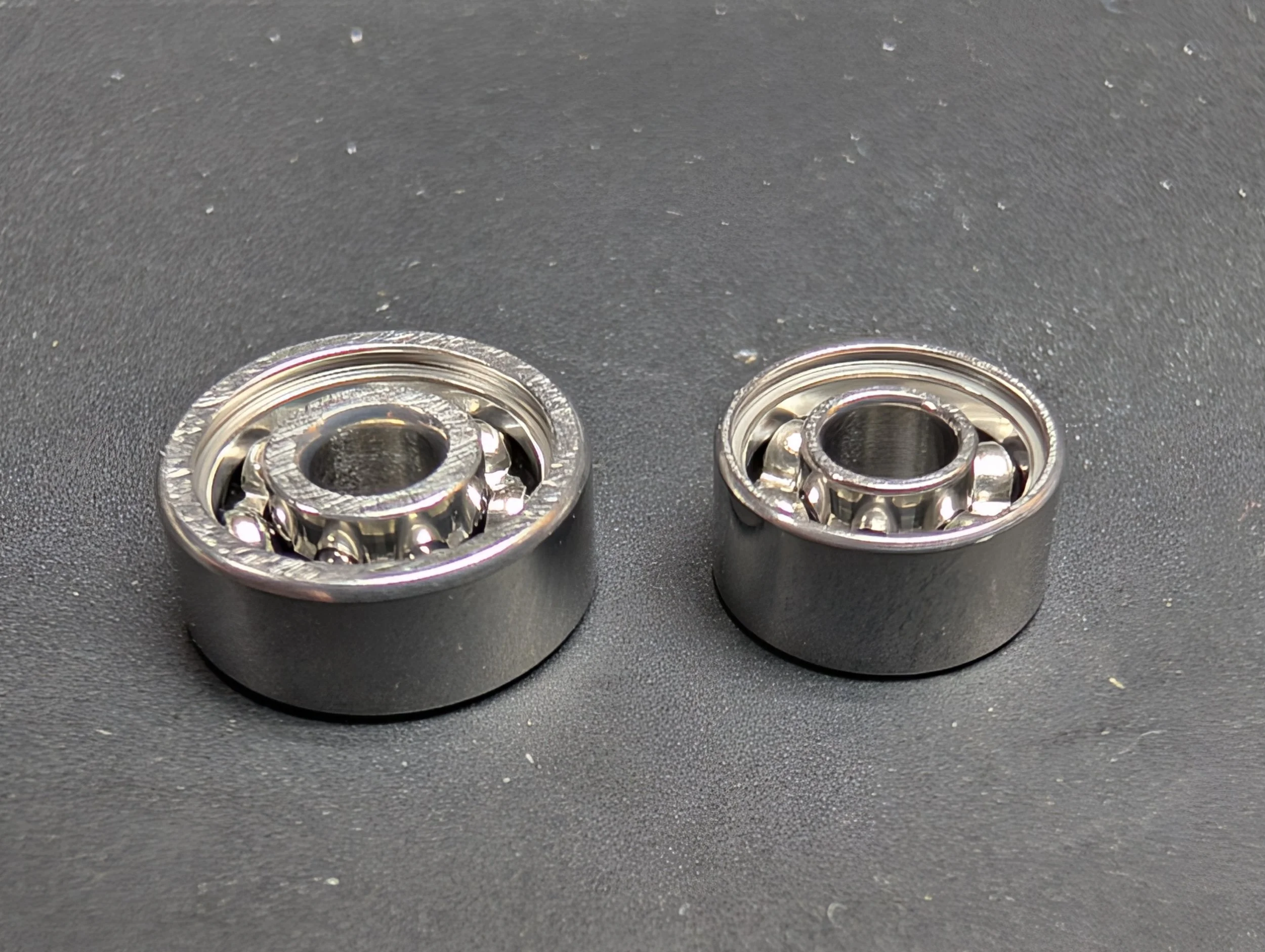
The same bearings above, cleaned and ready to oil and install
With that out of the way, where do ceramic hybrid and silicon nitride bearings truly make a difference? The answer is saltwater. Not because of perceived benefits in performance, but because of the anticorrosive properties. When saltwater gets inside of a bearing, the water evaporates leaving the salt behind. With a stainless bearing, salt residue can pit the surface of steel, compromising performance. Full silicon nitride is immune to this, but ceramic hybrids are not since the raceways and ribbons are often stainless or chromed steel, so those too must be lubricated. Even if silicon nitride or ceramic hybrids are warranted for your uses, it’s still better to get them from a reputable manufacturer for peace of mind and longevity. NMB and NSK of Japan, GRW of Germany, and SKF of Sweden all offer truly excellent bearings, all of which were used in European and Japanese reel brands at one time or another. In many cases these bearings will be cheaper than the rebranded bearings you see many shops pushing. That about wraps it up. Hopefully you’ve learned something and are now wiser to the marketing. As always, happy fishing and keep your stick out of the water.