
Bearings have been an essential part of fishing reels going back nearly 70 years. First in spinning reels for the rotor, then later on to baitcast reels for the spools. While not as durable as bronze or even nylon bushings, they certainly feel better, and in the case of a baitcast reel, perform better. Bearings are often used as a marketing ploy by manufacturers to paint their products as superior to their peers, which often comes at the detriment of durability. Your average fisherman is of the mentality that more is better, and while this is true to a point, it’s the manner in which they are used that is far more important.
Let’s take the level wind as an example. A popular upgrade is to replace level wind bushings for bearings. Outside of synchronized level wind reels, there is no net benefit to swapping the nylon bushings for bearings. The level wind is exposed to the elements and purposely built to loose tolerances which ensures it functions barring any catastrophic failure. The bushings installed from the factory better withstand contaminants, be they dirt or even salt. Add bearings to the mix and you introduce points of failure. If one or both bearings fail, so does the level wind. This ultimately makes the “upgrade” pointless. It's cool for bragging rights, but not long term durability unless you're very vigilant with maintenance.
What we are about to embark on is obtaining a thorough understanding of miniature bearings and why most of those sold on prayers, hopes, and dreams aren’t worth their asking price, or even the wholesale prices paid for them by the shops that resell them. Those shops market on technical jargon they don’t understand; primarily the ABEC system because “more is better”, when in fact it can be detrimental to your experience. Part of my modus operandi with Ashlin Fishing is exposing myths and marketing in fishing equipment to give others a better understanding of the nuts and bolts and what makes a product exceptional enough to be worth your time, money, and effort.
In the paragraphs below, we will explore key International Organization for Standardization specifications covering dimensional tolerances, internal clearances, quality management, and even the balls. These standards are employed by every single renowned manufacturer of miniature bearings such as NTN, NMB, NSK, SKF, GRW, and a whole host of others. Where are they not applied? Most of the no-name or rebranded products out there may follow some of them at best, or none of them at worst. They’re buying inferior bearings from questionable manufacturers nobody has heard of. Some of these re-brands are very popular in the fishing community because they rely on elaborate marketing and subjective “test” results to move products. These re-brands are often sold at an extreme mark-up, often 2000% (you read that right) or more of what their wholesale cost is. If you look around on any fishing related website, forum, or social media group, you will see their names thrown around because they have achieved market penetration by selling to customers who don’t really understand bearings themselves.
The point of marketing is to convince the lowest denominator that their product is the superior option. Not by giving detailed manufacturing data sheets, but to state their case via parlor tricks with elaborate technical jargon and a heap of bullshit mixed in. This is how marketing works whether you’re buying a reel, bearings, or even a vehicle. The truth is always buried in the more boring details, not the “look at me” stuff shown in 30 second video snippets. As always, the devil is in the details because let’s face it, nobody wants to sit and read tables of manufacturing data that they can’t interpret. That’s what my point is here, to help make that data digestible so that you are armed with a better understanding.
Where I am going to begin is with the famous, and heavily marketed ABEC scale. For starters, the ABEC system is often used for marketing because it’s easy for the average Joe to digest, but where Joe fails is in understanding the ABEC scale, much like the resellers of the bearings he purchased from. What the ABEC scale designates are purely related to external, or dimensional tolerances; how a bearing fits to a shaft or housing and the allowed deviation from those manufacturing tolerances. It also designates things like axial runout as well as inner and outer ring runout, or how rotational defects cause the bearing to shift axially off a true, flat path. The ABEC scale is in odd numbers; 1, 3, 5, 7, and 9, with each increment higher representing a tighter dimensional tolerance than the previous. For a bearing to be considered precision, it must meet ABEC 1 dimensional tolerances at minimum.
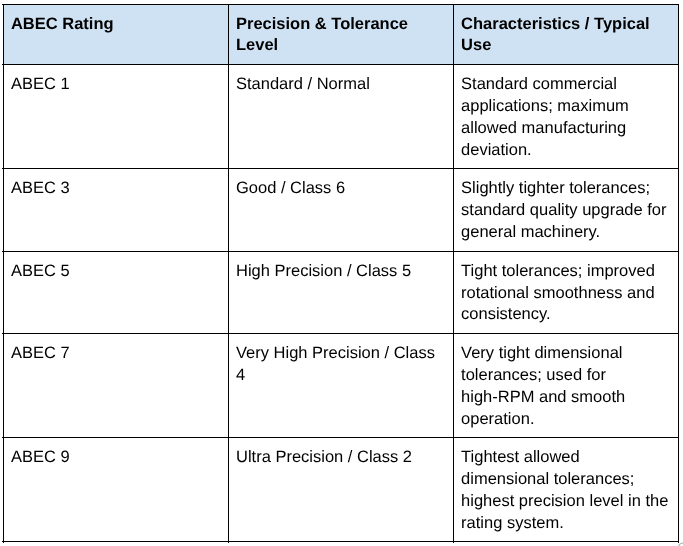
The oft-cited, but misunderstood ABEC scale
For all intents and purposes, the Japan equivalent of ABEC is the JIS B1514 standard, which is very similar, but while ABEC numbers go up as tolerance tightens, B1514 standards go down; with P0 being normal and P6, P5, P4, and P2 being the tightest. Japanese manufacturers of bearings like NMB, NSK, EZO, and NTN follow these standards, while those in the USA follow ABEC. Additionally, there is the ISO 492 certification, which is an internationally recognized scale for dimensional tolerances usually employed outside of the USA and Japan. ISO 492 classifies precision bearings as normal, 6, 5, 4, and 2.
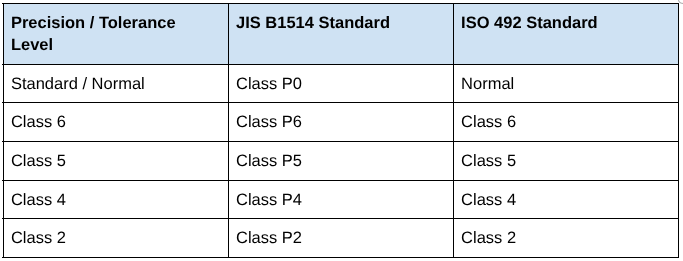
JIS and ISO standards, equivalent to the ABEC scale used in North America
As it is marketed, the ABEC scale does not involve internal clearances as the resellers market them. That is the point of ISO 5753-1, which applies to the clearance between the balls and raceways.
ISO 5753-1 is the standard most often confused with the ABEC scale. This is one to look out for because most of your fly-by-night bearing manufacturers are not ISO 5753-1 certified. This is important because this is the standard that pertains directly to radial internal clearance between the balls and raceways. This is where many people confuse it with ABEC, because it is widely believed that ABEC 7/9 bearings have very tight internal clearances, and exactly how the bearing resellers market them. Think of some of the most prominent reel bearing brands, virtually none of them hold this standard. Your ear can even tell you this standard isn’t followed, as looser tolerance bearings are exceptionally loud, whether steel or ceramic. The whole “ceramic is harder, more round, and therefore louder” argument is yet another facet of marketing jargon. Truly good bearings aren’t going to wake the dead regardless of the materials they are made from. Loose clearances are not only louder, they just perform well on the bench under zero load, not under load.
Any bearing manufacturer worth your time will have all relevant data available. They do this because the same bearings found in fishing reels are also used for automotive, aerospace, military, and industrial applications. Those are specialized roles, and to use an inferior bearing that doesn’t meet all of the requirements can potentially lead to catastrophic failure. You aren’t going to find fancy orange seal bearings from Florida (China) driving the analog instrument cluster of a Boeing 747. You also won’t find them in dental drills or stepper motors, for very good reason. So why put them in a fishing reel?
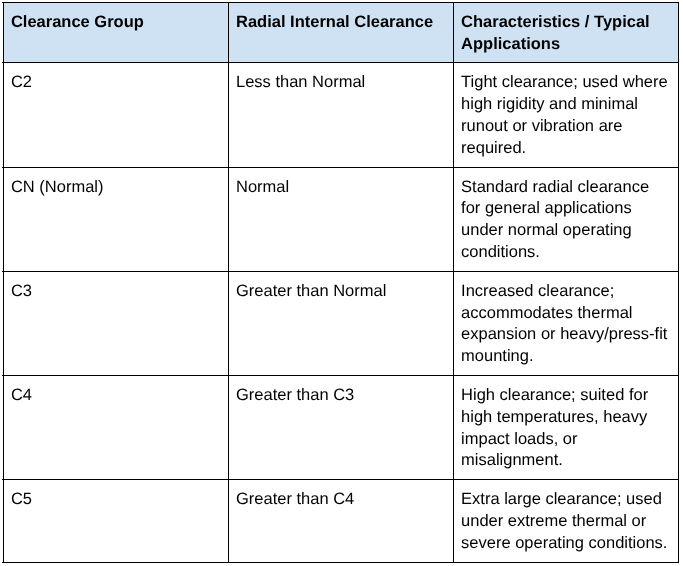
Clearance standards, showing which classes pertain best in accordance with usage
Next we will discuss ISO 21920, which dictates surface finish quality of the raceways. Noise is often a sign of a raceway having a rough finish. Many overly marketed bearings not made to any particular standards will be loud with a rough raceway finish working in conjunction with a loose internal clearance. These bearings can appear to be super fast because they are demonstrated at zero load, but as stated above, aren’t going to perform optimally under actual fishing conditions. They’ll look great on video though. ISO 21920 goes by roughness average per micrometer, expressed as Ra/µm, or thousandths of a millimeter. The lower the N value, the better the finish. Most quality miniature ball bearings will have a surface roughness class in the N4 to N5 range and be exceptionally quiet under load or no load at all.
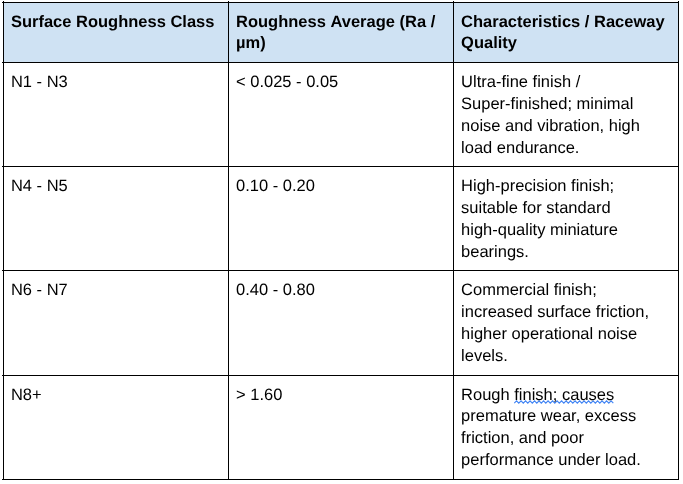
Roughness grades of raceway finishes
Lastly, we have ball quality, denoted by ISO 3290-1 for steel balls, and ISO 3290-2 for ceramic balls. These standards govern attributes like precision levels, sphericity, hardness, diameter variation, and surface roughness. If the raceways are the meat, the balls (no pun) are the potatoes. As we can see in the chart below, there really isn’t much of a difference between the roundness of ceramic and steel balls, as they are made to the same standards. There is a very common misconception that ceramic balls are more round, so keep in mind they are both made to a standard, at least by the legitimate manufacturers anyway. Your no-name shops in Shenzen that like to sell cheap crap to resellers that will most certainly mark them up through the roof? They don’t abide by them.
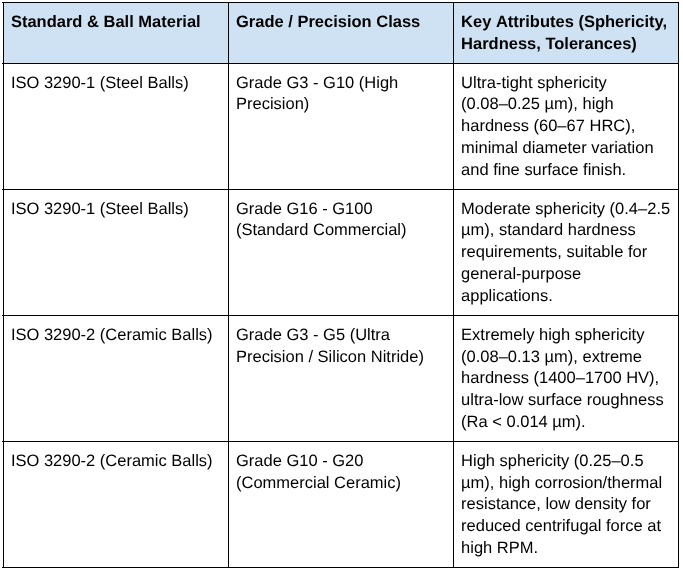
ISO ball grades for both steel and ceramic balls
Now that this is all out in the open, pay attention to what you are buying. Long established bearing manufacturers have all relevant manufacturing and objective test data available to all, you just need to find it through their sites. Now much of this you aren’t going to find in a bearing catalog from said manufacturers, but they do have this data as an additional resource to compliment their catalog. Anybody can be ISO 9001 certified, it just means that a manufacturer has some semblance of a quality system in place, not necessarily any other certifications. To be ISO 492, 5753, 21920, and 3290 certified? That means you are a legitimate manufacturer who knows their products well and adheres to standards put forth by international bodies, whether for safety purposes, durability purposes, or both.
The truth is, most of the stuff you see in fancy packages marketed on unrealistic claims will certainly meet ISO 9001 and maybe another certification, but virtually none of these back alley shops meet all of them, and this is why they have measured inconsistencies in end performance, because they lack some or all standards. Just because they cost $20 each doesn’t mean they’re good, and truthfully, the established manufacturers have been doing this for so long, their superior products are priced at a fraction of just about everybody that sells hyped up bullshit just because they make in such high volumes and support virtually all mission critical appliances, tools, and instruments.
Do your due diligence and consult manufacturer catalogs and documentation. This is what the reel companies do, because their engineers need that data to design a product that both performs well and is reasonably durable. Chances are, the bearings already in your reel may already be excellent and just need a thorough cleaning and the correct lubricant to really fly. As always, thanks for reading and happy fishing!