
the mechanics of reel handles
A common modification among us reel nerds is swapping factory handles for oversized aftermarket assemblies. While often done for looks or under the assumption that more leverage is always better, handle length can’t be evaluated in isolation. In a fishing reel, handle length, gear ratio, and spool diameter work together as a single system governed by mechanical advantage.
The Mechanical Advantage Formula
A reel is a simple machine. When you turn the handle, that force transfers through the gear set to rotate the spool against the resistance of the line, lure, and fish. Because the spool turns multiple times for every single handle rotation, the output leverage you have on the line depends directly on your gear ratio and spool size.
Using standard reel specs; pin-to-pin handle length and spool diameter in millimeters, you can calculate the reel's Mechanical Advantage (MA) with a simple equation:
Mechanical Advantage (MA) = Handle Length / (Gear Ratio × Spool Diameter)
In simple terms: a higher mechanical advantage number means the reel feels easier and lighter to crank under load, while a lower number means the reel feels stiffer and requires more effort to turn.
How the Three Variables Interact
Every time you change one of these three parts, you change how the whole reel behaves:
Gear Ratio: Sits on the bottom of the equation. Stepping up from a 6.3:1 to an 8.1:1 gear set cuts your mechanical leverage by roughly 22%. Without changing the handle, the same lure resistance feels about 28% stiffer.
Spool Diameter: Also sits on the bottom of the equation. A larger spool diameter pulls in more line per turn, but it gives the lure a longer lever arm against your hand, making the reel harder to crank under heavy tension.
Handle Length: Sits on top of the equation as your input lever. Lengthening the handle gives your hand more leverage, directly offsetting the added resistance caused by high gear ratios or large spools.
The 0.38 Sweet Spot Rule
Reel manufacturers historically dialed in factory configurations around a balanced Mechanical Advantage between 0.35 and 0.42. For example:
An 80 mm handle on a 6.2:1 reel with a 34 mm spool: 80 / (6.2 × 34) ≈ 0.380
An 84 mm handle on a 6.3:1 reel with a 34 mm spool: 84 / (6.3 × 34) ≈ 0.392
A factor of 0.38 represents the sweet spot. It keeps winding effort comfortable while preserving feedback and allowing a natural wrist cadence without much wobble in the rod. To find the ideal handle length for any gear ratio and spool diameter, use this quick shortcut: Target Handle Length ≈ Spool Diameter × Gear Ratio × 0.38
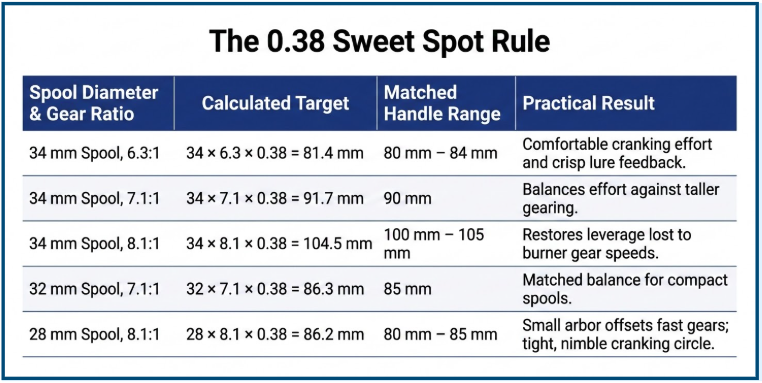
A simple table detailing the Leverage Index of handles in relation to spool diameter and gear ratio
The Leverage Index: A Quick Bench Check
Before swapping handles on a reel, check its Leverage Index to see where it lands:
Leverage Index = Handle Length / (Spool Diameter × Gear Ratio)
Below 0.34 (Under-Leveraged): The handle is too short for the gearing and spool. Pulling resistance feels heavy and hand fatigue sets in quickly.
0.35 – 0.42 (The Sweet Spot): Easy winding effort, clean wrist rotation with minimal wobbling of the rod and maximum feel of the lure, bites, and structure.
Above 0.45 (The Aesthetic Trap): The handle is oversized for the gearing. The extra leverage dulls vibration back to your fingertips, numbing bite detection, while the large turning circle forces unnatural forearm movement. I liken this to churning butter. A handle of excessive length has a much longer throw and will require the forearm to be used instead of pure wrist cadence.
As we can see, there is a sweet spot to be found somewhere between tough to crank and churning butter. Reel engineers know this and design their products accordingly. The aftermarket? Not so much. They tend to sell more on aesthetics over functionality. With this out of the way, where are exceptionally long handles a true advantage? The answer is bigger conventional reels used for offshore fishing, trolling, bottom fishing, or large species. Tactics where lures aren’t repeatedly cast and retrieved, but sitting out there until a hungry fish takes it. Then there are high resistance baits that are often used by the pike and musky guys. Those too will benefit from a longer handle as it makes coping with the drag produced by the lure much easier.
For the people working lures in the hopes it entices a bite, it is often best to respect the leverage index above as it will make their fishing more enjoyable and less fatiguing. Of course you can deviate from this and as described above, it will mostly be for specific usage cases such as still fishing and high resistance baits.
As always, happy fishing and thank you for reading. Hopefully this article dispelled some myths and made your time choosing a new handle more fruitful.