
bench craft: turning assembly-line reels into precision machinery
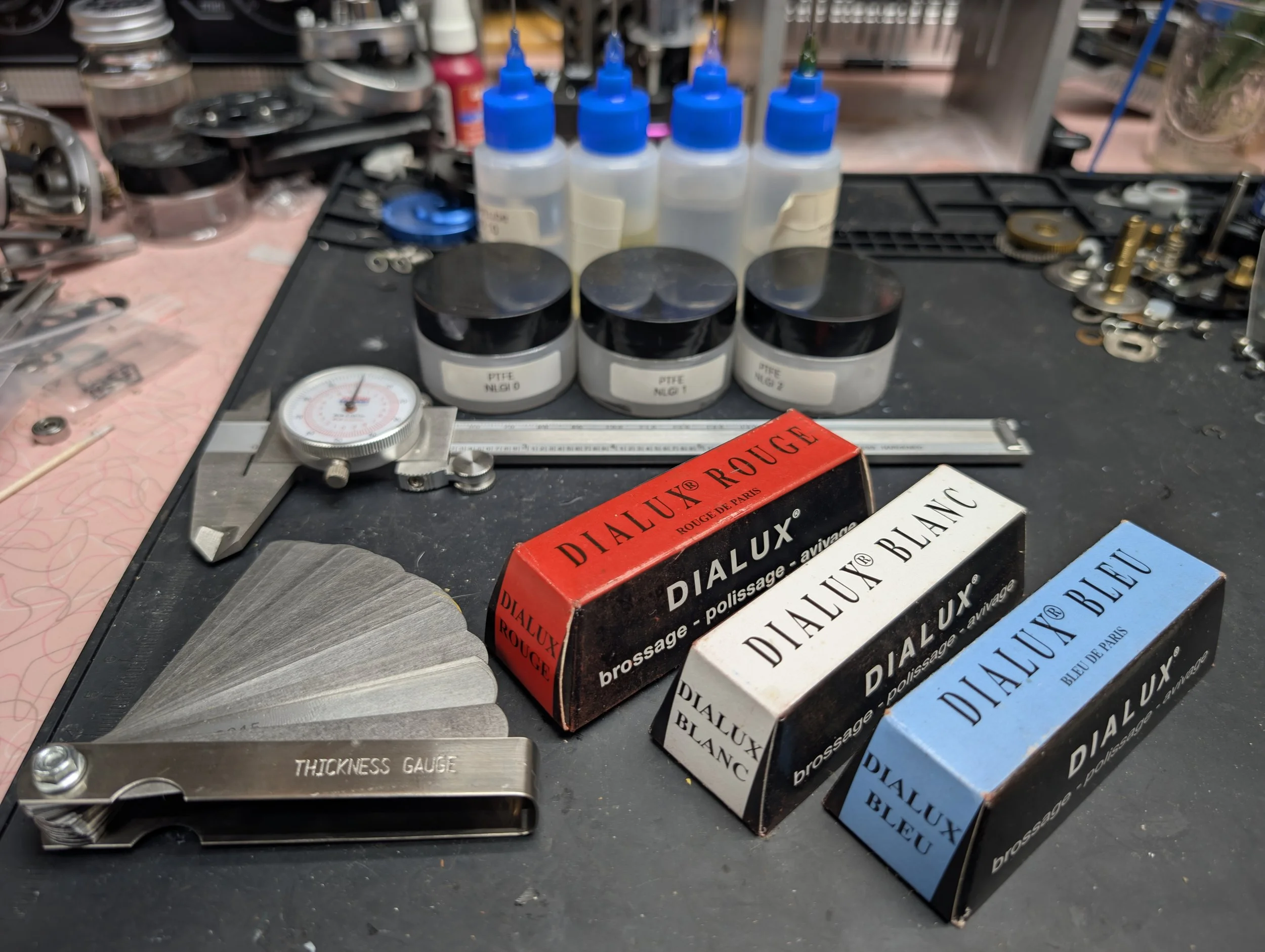
Some of the tools and materials used for a tune
When I share my work at Ashlin Fishing, people frequently ask about my tuning process. As always, I’m more than happy to share so that I may improve your own skills as well as clear up any misconceptions. I started out in this endeavor learning from others like anybody else along with my own experimentation. Sharing what I have learned along the way is my contribution to the world of fishing. Over my years of participating in online discussions, I pride myself in being helpful above all else. Nothing joys me more than seeing others use, or even refine my own methodologies. I don’t know all of the answers, and I am always looking to learn at the same time. That said, let this serve as a foundation to the freshly minted technician who wants to make the most of what they have.
To start, tuning must be intentional. What is the ultimate goal? There is no universal tune, and tuning without a clear purpose creates long term usability problems. That distinction separates a standard technician from someone who evaluates every component. My process targets specific outcomes. The goal is never maximizing bench free spool or absolute casting distance. Metric driven tuning of that nature is a losing strategy for the angler, even if it makes an easy sale. Too many variables exist, which leads to frustration.
What is tuning? People frequently use the term supertuning. In practice, supertuning serves mainly to drive online engagement. It works for tricks, but practitioners rarely explain their rationale. Beyond quick excitement, it offers little value. Overly sensitive reels require heavier braking, increased thumb control, and maybe extra spool tension. Compensating for added spin cancels out any potential advantage. Subjective impressions are not proper measurements. Real tuning applies physical principles to tailor a reel to your exact requirements.
Most so-called supertunes rely on cheap bearings with loose tolerances to impress viewers on a bench. Sellers acquire them inexpensively from uncertified manufacturers, while shops promote them using misunderstood technical jargon rather than sound principles. Consider the ABEC scale. Misinformation leads many to assume ABEC measures internal bearing clearance. In reality, it only specifies external tolerances relative to the shaft or housing it will be used with. Precision bearings require an ABEC 1 rating or JIS P0 rating at minimum. Major manufacturers install ABEC 1 or P0 bearings because they engineered the reel for those exact specs. They partner with established manufacturers to ensure consistent quality. I use those same reputable brands because consistent performance is essential. With no-name or re-branded bearings, there is measurable inconsistency. Even bearings sold by brands that primarily cater to the fisherman will display these inconsistencies. Simply put, they are marketing on a general, or even mutual misunderstanding of their products. The impressive numbers they are marketed on cater to the innate human mentality of seeking abundance.
Now say this with me, parts swapping is not tuning. Tuning is the final refinement. It involves precise techniques to harmonize all components, ensuring predictable operation and a balance between control and free movement. You can tune a stock reel or an upgraded one. For example, tuning a vehicle involves adjusting the air/fuel ratio, ignition timing, shift points, throttle response, and rev limits. A stock or modified car can be tuned. Similarly, tuning a reel means optimizing friction surfaces, internal clearances, braking behavior, and lubrication.
Tuning often corrects the limitations of mass production. Factory assembly emphasizes speed and volume, whereas a tuner focuses on precise lubrication, bench testing, smoothing rough contact areas, and applying specific lubricants based on the reel's intended role. A single method cannot fit every situation. Proper tuning adapts the reel to your needs, turning it into a reliable tool rather than an unpredictable piece of gear. On water performance matters far more than a video clip on a bench. That said, video bench tests do have some merit; primarily after the reel is tuned and lubed according to its intended purpose. This shows real maximum potential while allowing for the technician to make adjustments so that it is user-friendly on the water.
Now let us examine the materials. We begin with polishing compounds. Many technicians use general metal polishes like Simichrome or Flitz. While useful for final touches, I prefer keeping three distinct abrasive grades on hand: 800 grit, 1500 grit, and 1800 grit. The 800 grit removes manufacturing marks and levels uneven areas. The 1500 grit smooths those surfaces, and the 1800 grit completes the finish while removing minimal material. These compounds are abrasive. A rotary tool at low speed works well with fine compounds, but coarse abrasives should be applied manually using cotton swabs or microfiber cloths. Using power tools with coarse grit can remove excessive material and widen critical tolerances. Clean off all residual compounds with denatured alcohol when finished. Polishing creates smooth contact surfaces by removing irregularities, unlocking the reel's full potential.
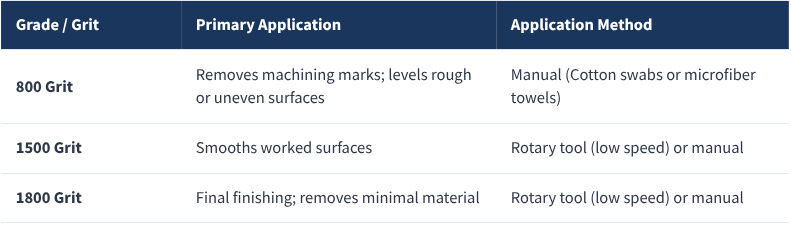
Various grades of polishing compounds and their uses
Lubricants allow you to customize both feel and response. I keep three grease grades ready. NLGI 0 is a semi fluid grease ideal for drag washers in BFS, ultralight, and cold weather setups. It provides low startup inertia, which is vital for light line applications because thick grease requires greater initial force to turn the spool. That initial resistance causes line breakage. A drag system should let the line flow smoothly rather than maximize holding power. Sticking or hesitation leads to lost fish, making NLGI 0 excellent protection for light line.
NLGI 1 has a soft consistency similar to tomato paste. I use it on clutch assemblies because it stays in place, allows smooth sliding action, and maintains consistency in cold conditions. It works well on gears for cold weather reels, preserving smooth operation near freezing temperatures. It also serves as a reliable drag grease for general purpose reels. Some use NLGI 1 on gears for warm weather fishing, but its lower shear stability allows it to migrate off contact areas easily. While it provides a light cranking feel, it offers less gear protection.
NLGI 2 is a standard medium grease best suited for general gearing. It remains in place longer, and its superior shear stability protects gear teeth better than lighter greases. This viscosity works well across general purpose, BFS, and ultralight spinning gear. Although the handle may not spin as freely on a bench, protection takes priority. We are tuning a fishing reel, not a fidget spinner. NLGI 2 also functions well on drag systems for big game species like sturgeon, catfish, musky, and salmon where heavy leaders are used. These fish generate significant friction, and proper grease thickness reduces drag wear during long runs.
For oils, TSI 321 is my preferred choice for spool bearings, spinning reel main shafts, and line rollers. While categorized as an oil, it is actually a thin film lubricant. Apply TSI 321, work it into the surface, and wipe away the excess. It contains a bonding agent that adheres to metal and fills microscopic pores, creating a slick barrier. Even after wiping, a faint scent confirms it remains active. It resists wear and typically requires solvents or mechanical force to remove. It is an exceptional spool bearing lubricant, backed by accessible technical data sheets.
ISO VG 220 gear oil works well on level winds, support bearings, and felt drag washers. It offers long service life, dampens bearing noise, and produces a connected feel. Although handle rotation inertia increases slightly, the lubricant remains active between maintenance cycles. Many technicians default to thin oils everywhere, but low viscosity oil breaks down quickly. Deeply seated bearings are difficult to relubricate frequently, making moderate to high viscosity oils preferable for durability. Proper tuning reduces required service frequency. Applying fluid dynamics helps build a reliable tool for field conditions.
Finally, I stock various oil grades such as ISO VG 22, 32, 68, and 100. These lubricate O-rings, brake surfaces, anti reverse bearings, and secondary components. I also use them for spool bearings depending on the application. They serve as specialized finishing lubricants rather than primary oils.
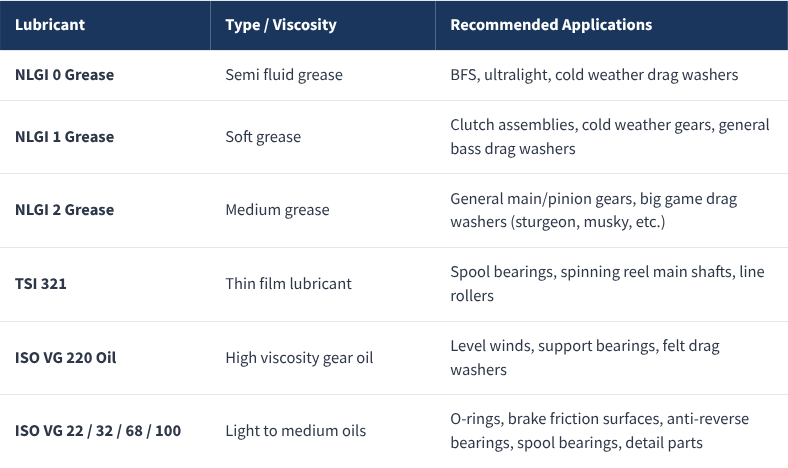
Table showing the lubricants used and their purposes
Avoid resellers promoting overpriced lubricants with unrealistic claims. Reliable manufacturers provide technical data sheets specifying operating temperature ranges, viscosity ratings, and additive compositions. This information allows you to predict performance accurately. Sellers claiming proprietary secrets often lack verifiable test data. Standardized testing evaluates lubricants objectively, and transparency indicates a genuine product.
Effective reel tuning requires more than chasing rotational speed. Real benefits happen on the water rather than a workbench. Generalized approaches fail to deliver tailored results. Tuning should account for specific target species, lure weights, and environment, balancing performance with long term durability. I share these methods to provide a clear foundation for anyone servicing their own equipment. If you prefer professional servicing, you can send your reels to my shop. Thank you for reading, and happy fishing.