
the artistry of the tune
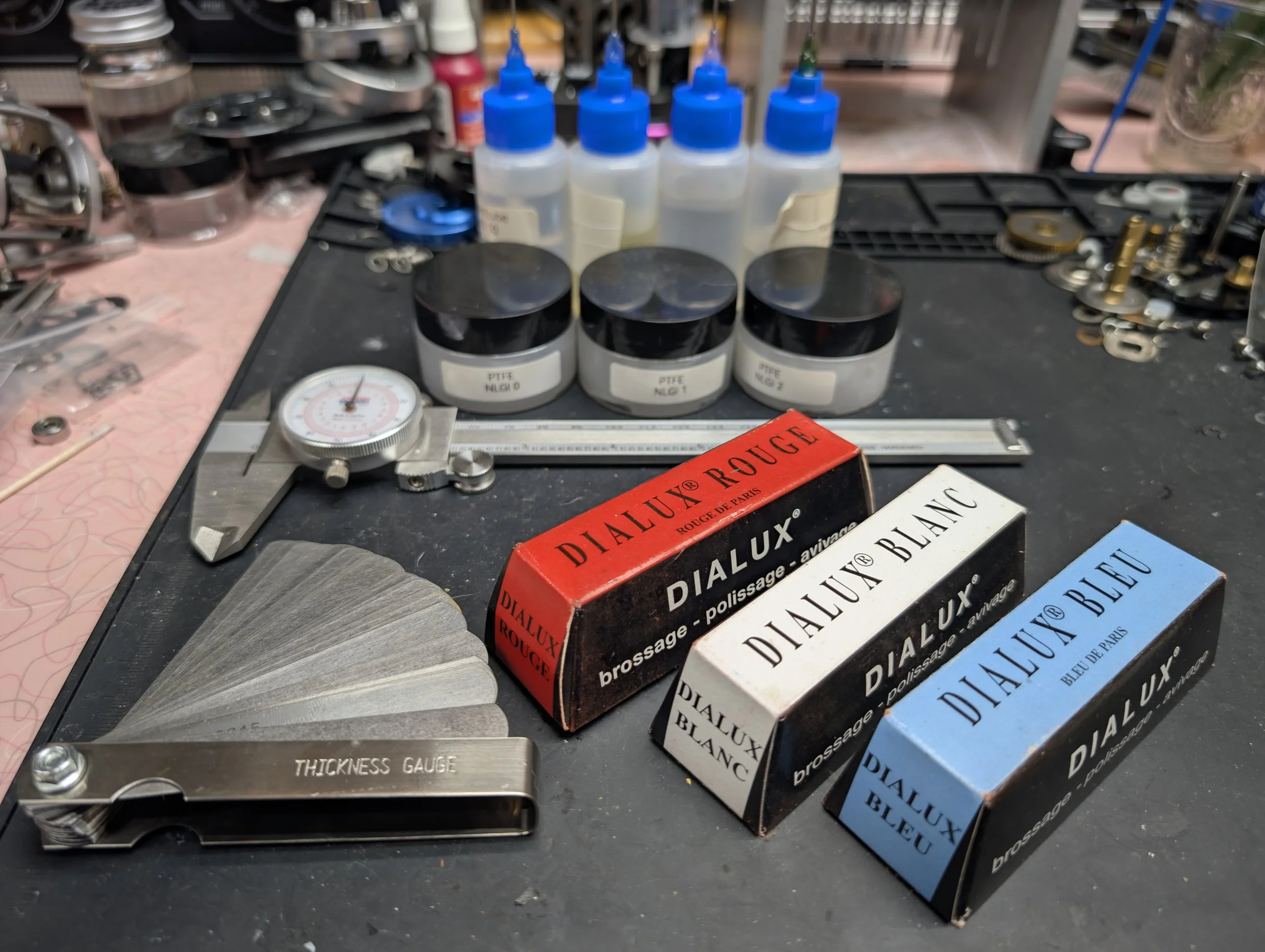
Some of the tools and materials used for a tune
A lot of the time when I post the work I do at Ashlin Fishing, I sometimes get questions in regards to my tuning process. I will say from the get-go, tuning itself should be done with intent; what is the end goal of the tune? The truth is, there is no general tune, and tuning without purpose will become problematic in the long run. This is what separates a run of the mill reel tuner from somebody that takes the sum of all parts into consideration. What I do has specifics in mind, and so should you. The goal is never to free spool on the bench the longest or to cast the furthest. Truthfully, tuning based on those metrics is a losing endeavor for the user, but an easy sale for the technician. There are simply too many variables to account for, and sometimes this ends in frustration.
With that out of the way, what exactly is tuning? One word we see needlessly thrown around is “supertuning”. Well, what is supertuning? Simply put, it’s conducive to what was mentioned in the above paragraph; with the sole intent to generate clicks and engagement online. Great for parlor tricks, but you seldom, or never see these guys explain why they are doing what they do. Cheap thrills, but that’s about it. Most of these racy reels need to be used with more braking, a more educated thumb, and maybe even more spool tension. Essentially, the added spin must be compensated for, which eliminates any potential gains from this method of tuning. Subjectivity is not a valid tool of measurement. To tune a reel means you understand the laws of physics and how to work within them to tailor the reel to your needs.
Most “supertunes” almost always involve inferior bearings with loose tolerances to show off on the bench. The bearing peddlers buy these for peanuts from non-ISO certified manufacturers, and sell them to the shops who use parlor tricks and manufacturing terminology they do not understand, not on established knowledge and how it relates to the end goal. Take the ABEC scale for instance; because of fly-by-night bearing peddlers, most confuse ABEC to be related to the internal clearances of the bearing. In reality, all it pertains to are the external tolerances in relation to the shaft or housing it is mounted on. To be considered a precision bearing, it must be a minimum of ABEC 1, or in JIS (Japan Industrial Standard) with a P0 rating. Most every reel from the major manufacturers comes with ABEC 1/P0 bearings. Not because the manufacturer is being cheap, but because they engineered their product to use them. This is why they are partnered with long established bearing manufacturers, because they consistently put out a quality product. This is the reason why I use bearings from those same brands, because I value consistency over everything.
Say this with me, changing parts is not tuning. Tuning is the icing on the cake; the techniques employed by the technician to make everything work together harmoniously and be user friendly enough to offer predictability and walk the fine line between control and chaos. Tuning can be done with a completely factory built reel or one that has been upgraded. For comparison purposes, when you tune a vehicle you are altering air-fuel ratio, timing, throttle response, and the rev limiter among many others. This can be done on a stock or modified vehicle. A reel is similar, except you are addressing friction surfaces, clearances, braking profiles, and lubrication.
Oftentimes, tuning is simply addressing the shortcomings of mass production. Where a production facility focuses on speed and volume of product, the tuner focuses on precision lubrication, bench testing to evaluate end performance, correcting rough friction surfaces, and applying lubricants of various thickness and viscosity according to where they perform best and what the intended purpose of the reel actually is. There is no one size fits all approach. Tuning is personal and truly makes the reel an extension of yourself, not a noisy uncontrolled animal that requires compensation to perform. What matters most is how it behaves on the water, not on the bench in front of a camera.
Now that we know what tuning is, let’s look at some of the materials used. The very first we will talk about are polishing compounds. You’ll notice a lot of tuners using metal polish like Simichrome or Flitz, and while they are good, they are best for the finishing touch on a polish job. I like to keep 3 grades of polishing compound on the bench; 800 grit, 1500 grit, and 1800 grit. The 800 grit is used for removing machining marks and to level rough or uneven surfaces. 1500 is to smooth them out, and 1800 is the finisher and removes the least amount of material. Remember, these are abrasive and while a rotary tool at low speed is great to use with the finer grit compounds, it is in your best interest to apply the coarse grit compounds with cotton swabs or microfiber towels. Using a rotary tool with such a coarse grit can remove too much material and loosen tolerances where they matter most, so go easy on the coarse stuff. Once you are done polishing, remove any excess with denatured alcohol. The idea of polishing is to make a smoother contact surface between components by correcting uneven surfaces. After that is done, you can realize the full potential of the reel.
Next, the lubricants. This is where you tailor both the feel and performance of your reel. I like to keep three grades of grease on the bench. NLGI 0, which is a semi fluid grease, works best with drag washers in BFS, ultralight, and cold weather reels. This is used to ensure a low inertia startup of the drag, important for light lines since thicker grease typically requires more effort for the first turn of the spool. This is when break-offs are most likely to occur and this is how that is mitigated. The idea behind drag isn’t how much it can hold, it’s how smoothly it lets out line. Sticking or skipping will lose you fish, and with lighter line oriented reels, NLGI 0 is good insurance.
Next up, NLGI 1, which is about the consistency of tomato paste. This is a soft grease and one I prefer to use for clutch assemblies since it stays put and makes the clutch components slide with ease, and it will not thicken too much in the cold. Speaking of, this is also great for use on gears for reels destined for cold weather use, since it helps the reel retain its smoothness as the temps get closer to freezing. It is also a fine drag grease for general duties and my go-to for a typical bass reel. While some do use NLGI 1 on gears for reels used in more pleasant weather, the low shear stability means it runs out easier, something that should be avoided. While the cranking will be marginally smoother greasing the gears with NLGI 1, they will not be as well protected.
Lastly, NLGI 2, or medium grease. This is your standard grease and best used with gears in general. It stays put better, and while it may not be as smooth as NLGI 1, the higher shear stability means the gears are better protected since it doesn’t run out as easily. This is a good thickness to use for most fishing reel gears, whether the reel is for general purpose, BFS, or ultralight spinning. While a reel handle may not spin as long using this type of grease, protection is by far preferred. We’re tuning a reel here, not a fidget spinner. NLGI 2 is also good for drag grease, primarily on big game reels for species like sturgeon, large catfish, musky, and king salmon where heavier leaders are used. Those are fish that can heat up a drag, and the correct thickness grease helps mitigate wear as those fish run.
On to oils. By far, my favorite spool bearing “oil” is TSI 321. As a matter of fact, this stuff is also excellent for main shafts of spinning reels and line rollers. I use oil in quotations because it really isn’t an oil, but a thin film lubricant. TSI 321 is best applied, worked in, and the excess removed. Why? Because it has a bonding agent that attracts it to metal and fills in the microscopic pores, leaving an ultra slick surface behind. Even when the excess is removed, you can tell it is still present by giving a quick sniff test, If you can smell it, it is present. It can also last a long time, and is usually only removed by a solvent or mechanical wear. This is the ultimate spool bearing lubricant, and like any lubricant worth using, has the data sheets available so you can judge exactly how it will perform.
Another I like to use is ISO VG 220 gear oil. I like to use this on level winds and support bearings on both spinning and casting reels as well as felt drag washers. It lasts a long time, quiets bearing noise, and gives a smooth and connected feel. While there will be a little more inertia when turning the handle, keep in mind that the oil will last in between services. Many tuners default to the lowest viscosity no matter the bearing, and thin oil runs out rather quickly. Some of those bearings are hard to get to in order to replenish the oil, so it is best to use a moderate to high viscosity for durability purposes. Tuning a reel not only tailors it to the target species, but in a manner that requires less frequent service intervals. This is where physics and fluid dynamics come into play and why they need to be understood in order to create a tool effective for the job at hand.
Lastly, we have the other oils. I like to keep various grades like ISO VG 22, 32, 68, and 100. These are used to lubricate parts like o-rings, some brake friction surfaces, anti-reverse bearings, and other odds and ends. These are not the meat and potato oils, but more for that finishing touch before I button it all up.
With lubricants in general, it is easy to fall into the trap of product resellers that make extraordinary claims for overpriced lubricants. They try to sell their products on the idea that they might just possibly bend the laws of physics. When in doubt, ask for technical data. Any lubricant worthwhile will have a data sheet available from the manufacturer that shows its ideal operating temperature range, test results at various temperatures, and what additives may be present. This is all good to know because then it is possible to judge the outcome based on the data available. The snake oil peddlers claim to not have that data and try to stand behind it being a trade secret. Remember, they’re full of crap and test data is obtained under controlled conditions, not the recipe for the lubricants themselves. They do this because they know they aren’t selling anything special. Marketing at work.
As we can see, tuning requires much more thought than “I want the fastest reel out there”. Any tangible benefits are realized on the water, not on the bench. A one size fits all approach is the lazy way because it’s easy to market, but that doesn’t achieve the end goal. Tuning a reel is highly species specific since it makes one tune in accordance with the lures they use and the conditions encountered. A reel should not only be tuned for desired performance, but for durability out in the wild at the same time. There is no elaborate trickery going on here and as always, I like to share my knowledge and be helpful to others. If you want to do it yourself, here is your foundation. If not, you can send it my way and I’ll do it up for you. As always, thanks for reading and happy fishing.