
bushwhackin’ on a budget
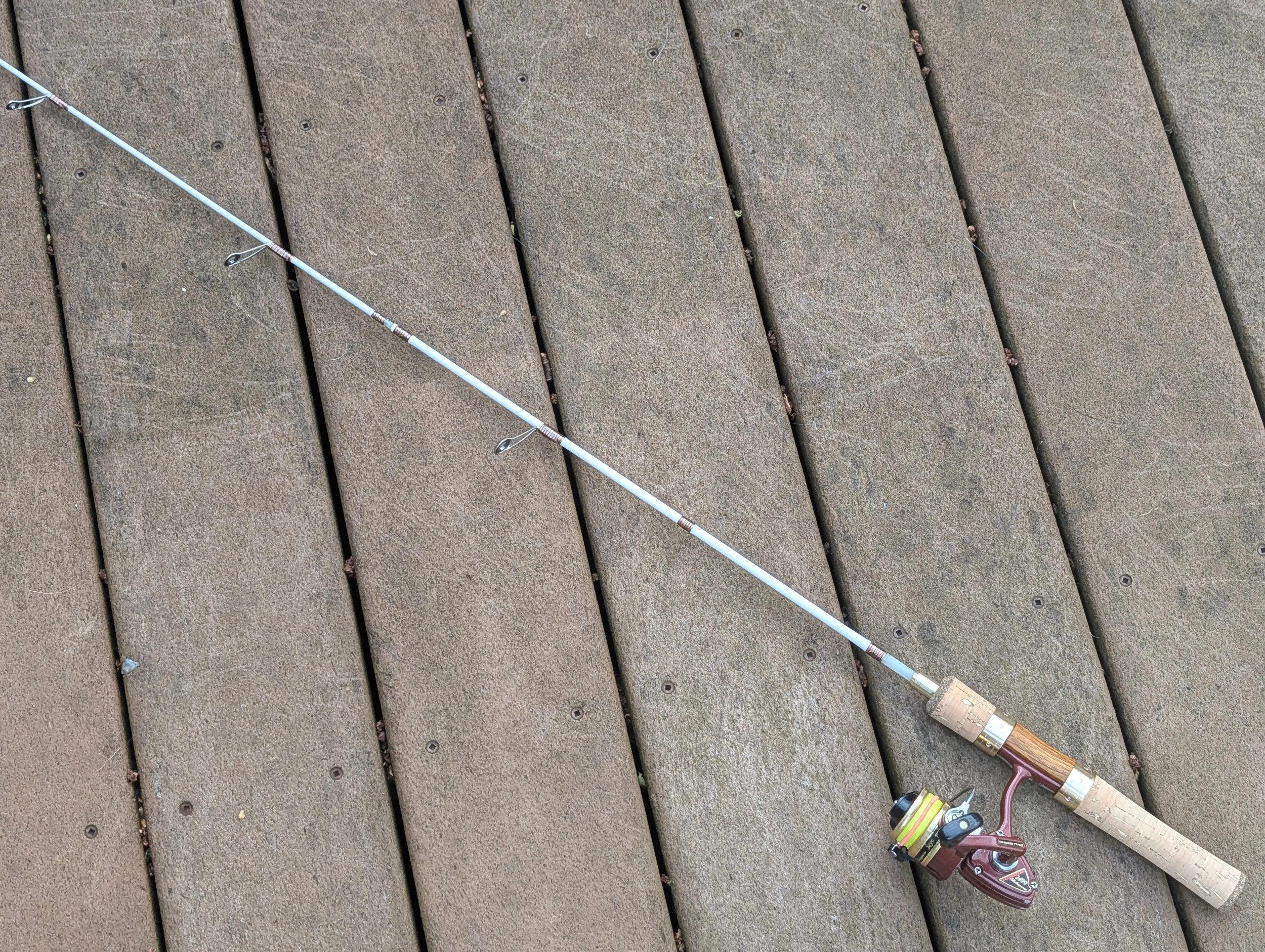
My $25 bushwhacker; a $5 Shakespeare 2499 and a $20 no-name 4’8” 0.8-5g (1/32-3/16) fiberglass rod
With the proliferation of cheap, and surprisingly decent quality rods from places like Temu and AliExpress, we somewhat find ourselves in a golden era of travel fishing equipment. Notice I said travel, because if you seek out a multi-piece rod, those stores pretty much carry it all. No US rod brands offer a multi-piece travel spinning rod at a cheap price, which is shameful as not everybody wants to walk the woods with a long stick poking up from their backpack. Brands like Purelure, Seasir, and Kingdom all offer 3+ piece rods, which tuck away right in your pack when you aren’t fishing. Many of these rods can be acquired for ~$30, and even less when a sale is going. While they are no Loomis or St. Croix, they are nice for the money, and work great in the rough and tumble environments such as game trails and overgrown creeks. What if it breaks? No big deal, get another or something else. There are many brands that I am not mentioning simply because there are so many. Find something that fits your budget and have at it. The more popular rods will have some commentary and reviews across social media you can view, and with more unknown brands one will need to read the user reviews where they are sold.
What am I looking for in a bushwhacking stick? First, I prefer fiberglass for its elasticity and durability. They are flat out more fun to fish with, even though they may lack the sensitivity of a graphite or composite rod. Fishing is all about fun, right? The rod should ideally be rated for 2-6lb line, but you can also go 1-4lb, or even 4-8lb. This is your call, so keep in mind the lures you are using and your target species. I tend more towards the 2-6 rods for this scenario since they are more a do-all versus the others. Since I am focused on resident trout, panfish, and smaller bass, a 2-6lb will do what I want. Next to consider is length. If you are like me and fish mostly in creeks and other small water, something short is ideal for both accuracy and not hitting stray branches. If you’re a pond hopper, you may want to opt for a longer rod for the increase in potential distance, but pulling double duty as a creek rod may be cumbersome hoofing it through the undergrowth. There is no right or wrong answer here, so choose as you see fit.
Now here is the fun part; the reel. This is where we are looking for quality, cheap quality. Does such a thing exist? Absolutely! Vintage micro-lite spinners. Those that are approaching 50 years old make the best candidates. Models like the Daiwa Mini Mite, Daiwa 500C and 700C, and the Shakespeare 2499 are some of my favorites. These reels are very simple inside and as tough as they come. They’ve already had a long service life and even the most banged up looking examples will still clean up and fish wonderfully. While you can browse eBay, you will pay accordingly. On eBay, these reels can potentially fetch $100+ due to how well reputed they are. If you do a little legwork, you will be looking in the $5-$20 range. They can be found at flea markets, garage sales, estate sales, antique shops, Facebook Marketplace, pretty much anywhere somebody is looking to offload old “junk”. Besides, this is how the eBay sellers acquire them and turn a profit. If you aren’t playing their game, you’re coming out ahead. Servicing them isn’t overly difficult either. More of that below.
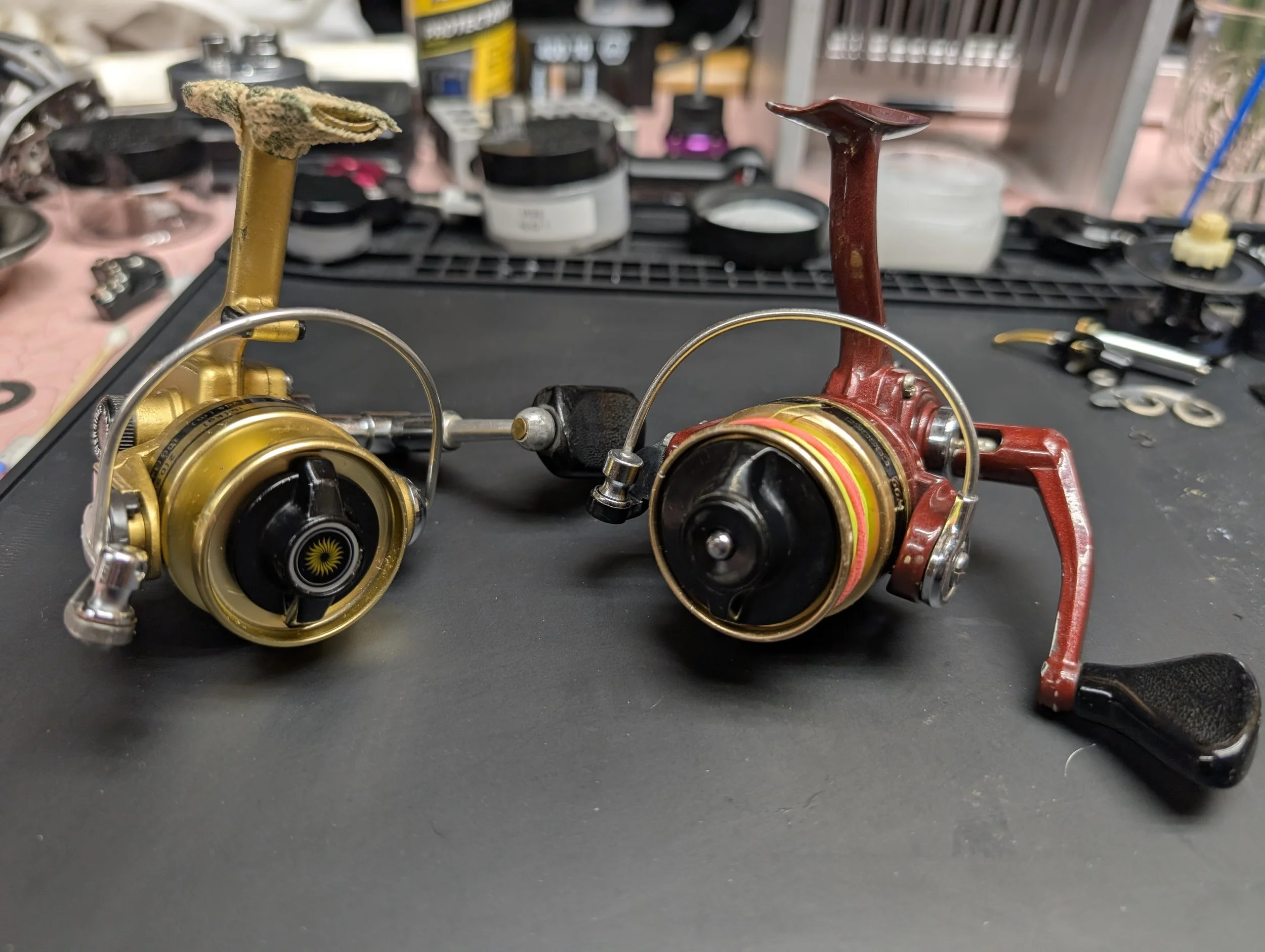
Daiwa Mini Mite and a Shakespeare 2499
Please be aware that once you obtain your reel, you may need to service it. Since these are small spinning reels we are talking about, any prepackaged grease and oil kit will work just fine. They’re quite simple and servicing is possible even by the beginner. Some of them have just 50 parts or even less. The modern models can often have double the amount of parts. Not only that, but among those parts in modern reels are a multitude of shims to keep everything lined up which can prove daunting for the freshly minted reel technician. The old stuff as laid out in this post is much more forgiving and easier to diagnose if something goes awry. Speaking of service, these are so simple that they can be serviced in the field if need be. A little Phillips/flat blade combo tool is all you really need. Simple may not be as quiet or smooth, but it is beauty in its own right. That’s why these are so loved in the first place; simple and reliable. Aside from fly and centerpin reels, nothing else fits that description any longer. We traded those aspects for smoothness, bearing count, reduced weight, higher potential drag, and cheaper quality components. The devil is in the details.
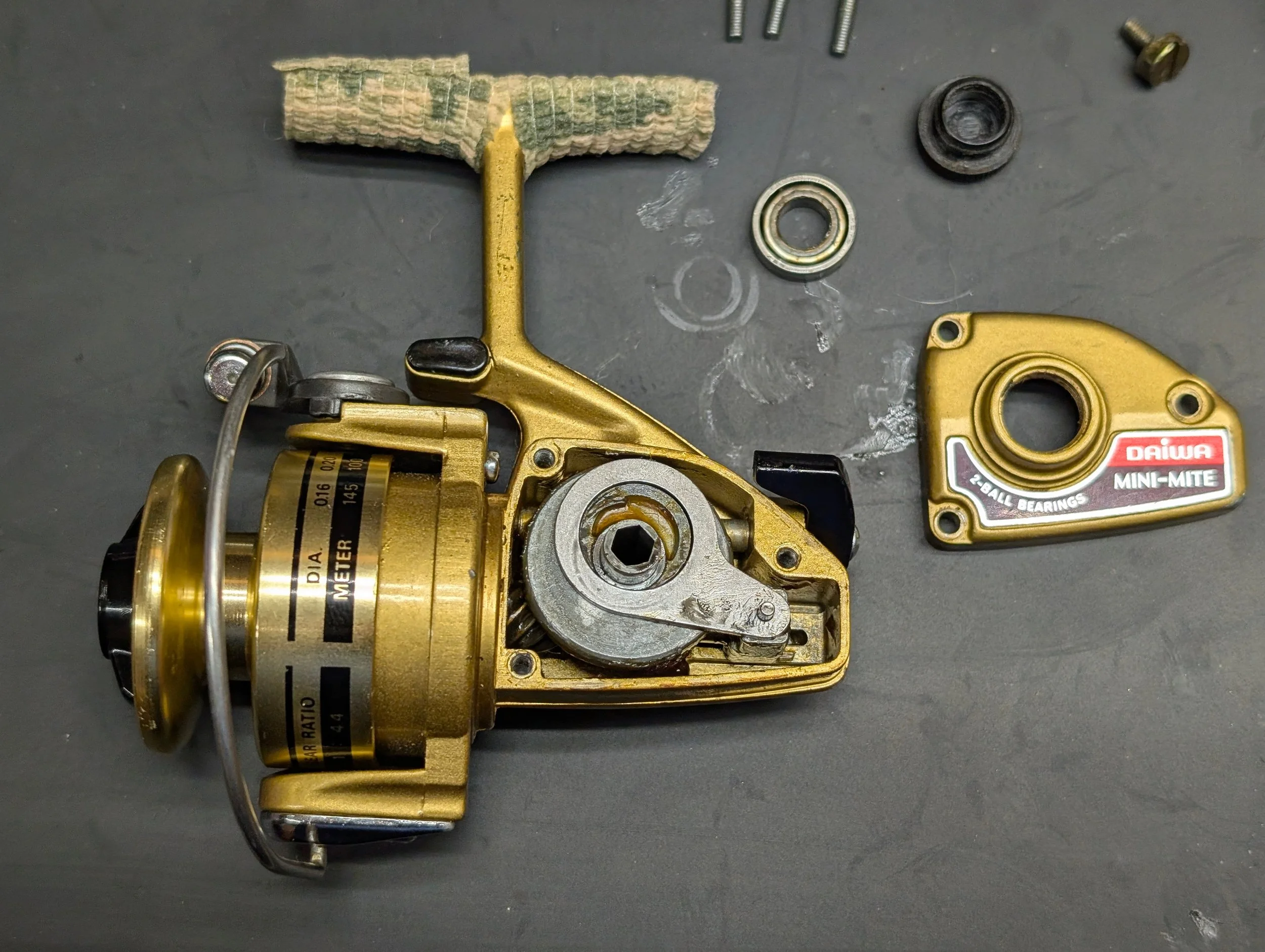
Not much going on in there
Now that we have our rod and reel, what about line? These tiny dinosaurs were designed for monofilament in the 2-6lb range. If you intend to use braid, ensure it is a similar diameter to mono, meaning 6-10lb. While you can use Japan spec polyethylene (PE), be mindful that can be very thin, especially the 0.3-0.6 diameters. With that, check your line roller area for gaps as that is where it is likely to get bound up. These reels have looser tolerances and sometimes don’t play nicely with the very thin modern polyethylene. If you are unsure if your braid will work, slide it through the line roller area and see if it gets caught. If not, you are good. If so, either use something thicker or try to add shims to fill in any gaps. Either way, you can always use monofilament. If you do decide to use braid, it is a good idea to back fill the spool with 10lb braided nylon. Old school braided nylon was used on baitcast reels prior to the middle 20th century and makes a fantastic backing material. Dacron is also good, which is commonly sold as fly reel backing today. Since this is a bushwhacking rig, you aren’t going to need 100 yards of working line on your spool. 50 is much more ideal, and using a thicker backing will fill in the empty space. Braided nylon can be hard to find in general, but it can be found at Mason Tackle Co. here in Michigan. They are a line maker and offer braided nylon from 10lb on up as well as Dacron. They seem to have the oddball products very few use in this day, but they are a great source nonetheless.
My goal with this was to show that a competent combo can be assembled for under $50, not including the line. $50 in general doesn’t get you much when it comes to fishing, let alone something that will survive the wild. Most of the time, the cheap combos do come with halfway decent rods, but where they fall short is the reel. Most of those reels are garbage to put it plainly, and many who buy them often return them or replace the reel with something better in short order. Doing it right the first time, you will be rewarded with a combo that will provide years of service for little pressure on the wallet. They also make great combos to teach your kids how to fish, especially if you are like me and gravitate towards fiberglass rods which are less brittle than graphite. Get out there, hit the sales and second hand shops, and get on the water. As always, happy fishing!